Acupuncture Points for Cerebral Ischemia Acute

5 sourced protocols, each with its citation.

Points cited for Cerebral Ischemia Acute

How often each point appears across the 5 entries ranked highest for Cerebral Ischemia Acute. Citation frequency, not a recommendation.

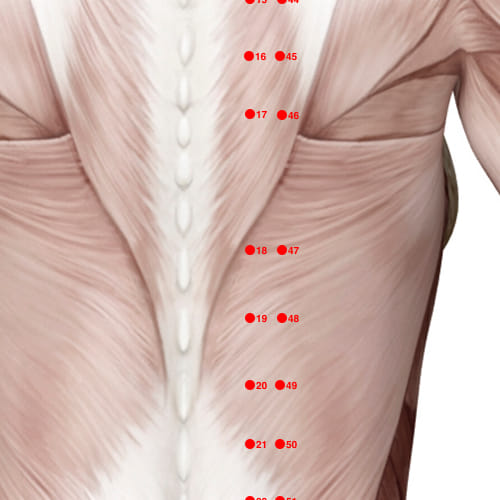
  • BL18Liver Shu PointBladder Meridian1 of 5
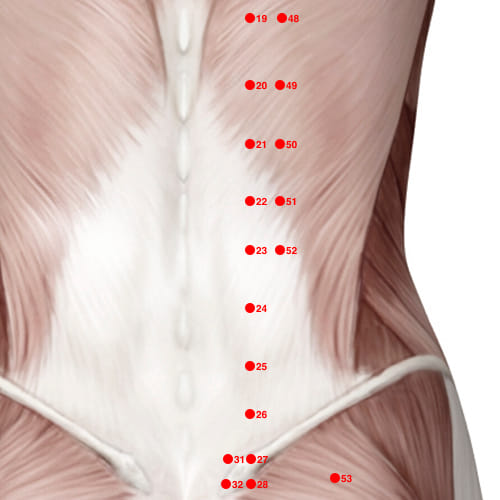
  • BL23Kidney Shu PointBladder Meridian1 of 5
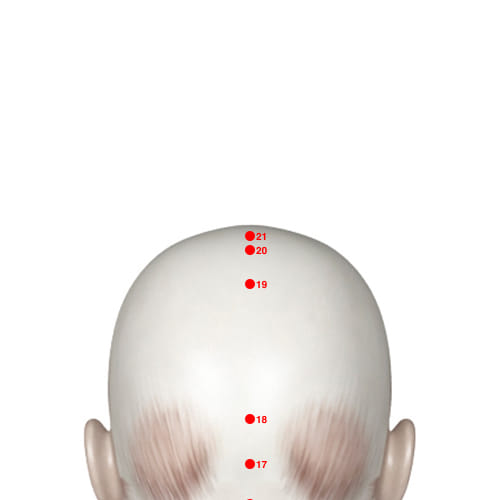
  • GV20100 ConvergencesGoverning Vessel1 of 5
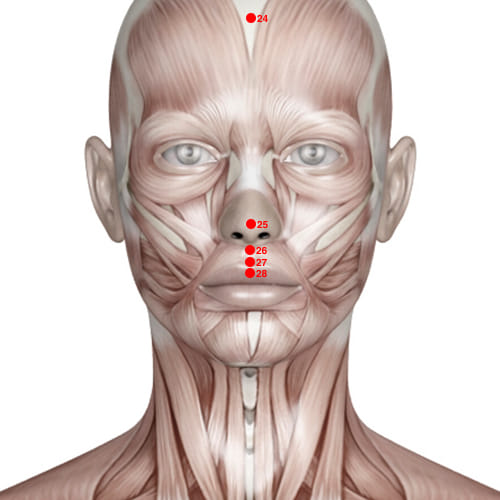
  • GV26PhiltrumGoverning Vessel1 of 5
  • LI11Pond At The BendLarge Intestine Meridian1 of 5
  • LU03Celestial StorehouseLung Meridian1 of 5
  • LU05Cubit MarshLung Meridian1 of 5
  • LU07Interrupted SequenceLung Meridian1 of 5
  • LU09Great SourceLung Meridian1 of 5
  • PC02Celestial SpringPericardium Meridian1 of 5
  • PC03Marsh At The BendPericardium Meridian1 of 5
  • PC06Inner GatePericardium Meridian1 of 5

How the studies delivered it

None of the studies behind these entries says how the points were stimulated or for how long.

After a treatment: what large safety surveys recorded, and which reactions need a doctor.

Each card names its evidence kind. What these labels mean

Protocol (4 points)

PC02 · PC03 · PC06 · PC07

Study-reported

Point selection reported in a published study.

doi:10.13460/j.issn.1005-0957.2021.13.2003 ↗
Not corroborated. No other study in the index uses any of these points for this search.
Locations and cautions4 points

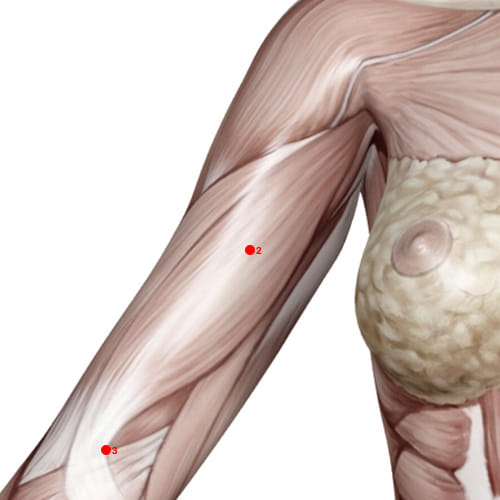
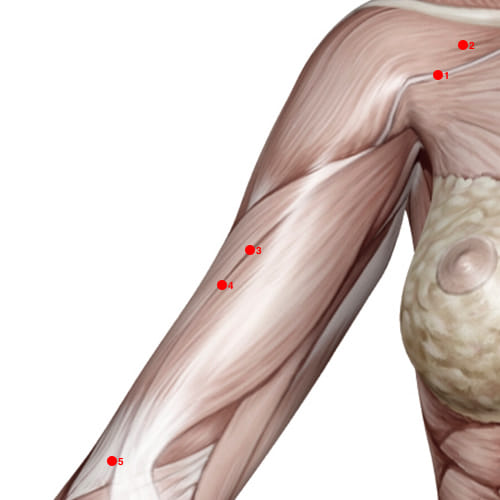
PC02Celestial Spring

PC02 acupoint
Click to enlarge

Click to view all layers

Meridian: Pericardium Meridian

Chinese: 天泉 (tiān quán)

Location: 2 thumb widths below level of the anterior axillary fold between 2 heads of the biceps brachii.

Cautions: Caution with brachial artery.

Listed for: Cough, Chest Pain, Palpitations, Chest Fullness, Blood Stagnation

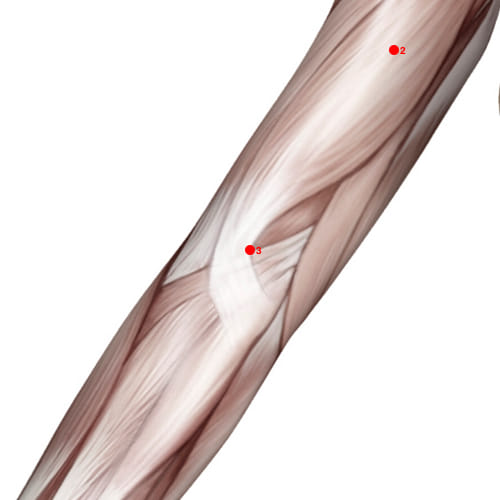
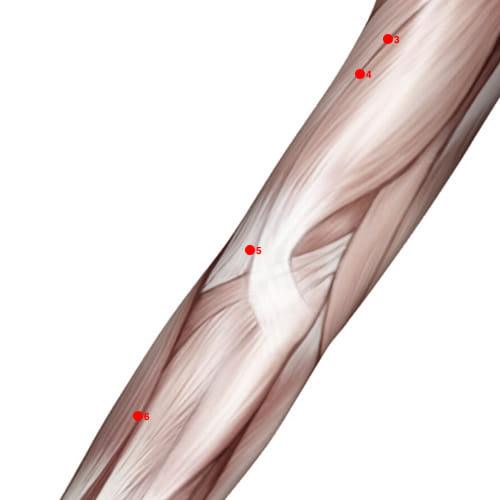
PC03Marsh At The Bend

PC03 acupoint
Click to enlarge

Click to view all layers

Meridian: Pericardium Meridian

Chinese: 曲澤 (qū zé)

Location: On the transverse cubital crease at the ulnar side of the tendon of the biceps brachii.

Cautions: Caution with median nerve and brachial artery.

Listed for: Cough, Diarrhea, Shortness of Breath, Coughing Blood, Palpitations

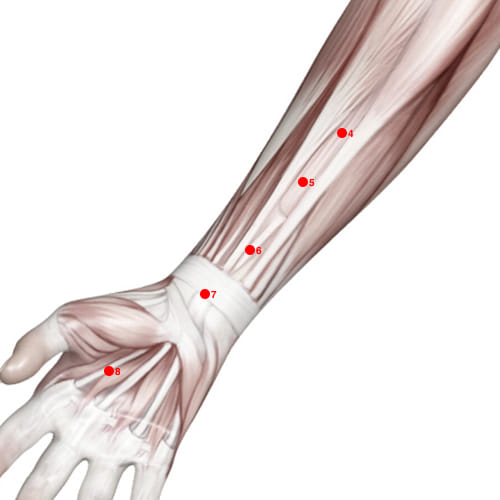
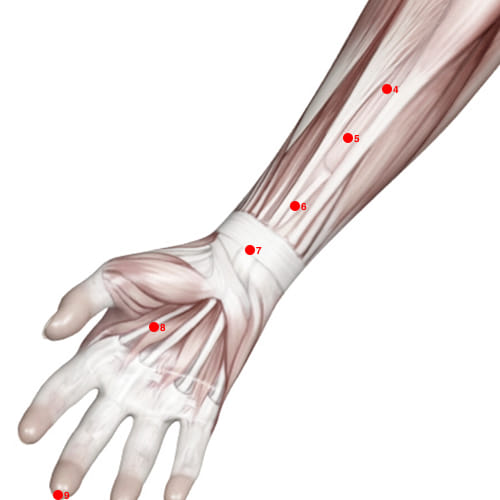
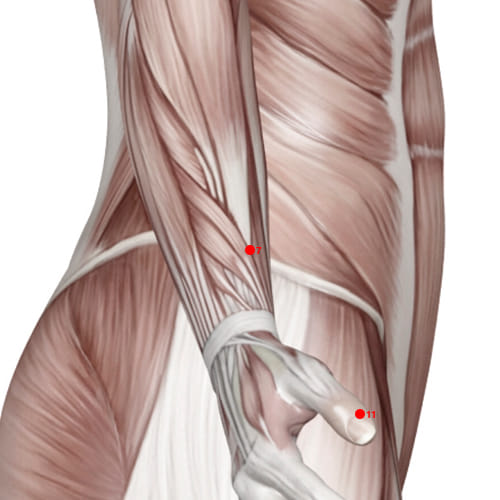
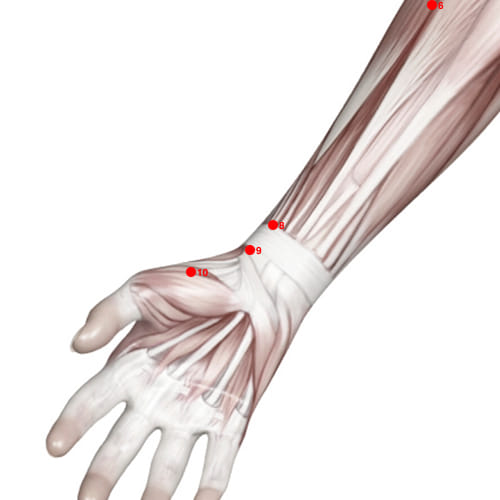
PC06Inner Gate

PC06 acupoint
Click to enlarge

Click to view all layers

Meridian: Pericardium Meridian

Chinese: 內關 (nèi guān)

Location: 2 thumb widths above the transverse crease of the wrist between tendons of the palmaris longus and flexor carpi radialis.

Cautions: Caution in severe deficiency conditions.

Listed for: Fever, Diarrhea, Anxiety, Dizziness, Spleen Qi Deficiency

PC07Great Mound

PC07 acupoint
Click to enlarge

Click to view all layers

Meridian: Pericardium Meridian

Chinese: 大陵 (dà líng)

Location: In the middle of the transverse crease of the wrist between tendons of the palmaris longus and flexor carpi radialis.

Cautions: No specific contraindications.

Listed for: Chest Pain, Fever, Anxiety, Palpitations, Jaundice

Protocol (4 points)

LU03 · LU05 · LU07 · LU09

Study-reported

Point selection reported in a published study.

doi:10.13460/j.issn.1005-0957.2021.13.2003 ↗
Not corroborated. No other study in the index uses any of these points for this search.
Locations and cautions4 points

LU03Celestial Storehouse

LU03 acupoint
Click to enlarge

Click to view all layers

Meridian: Lung Meridian

Chinese: 天府 (tiān fǔ)

Location: On the medial aspect of the upper arm 3 thumb widths below end of the axillary fold on the radial side of the biceps. brachii.

Cautions: Avoid deep needling; caution near brachial artery.

Listed for: Cough, Shortness of Breath, Asthma, Dizziness, Coughing Blood

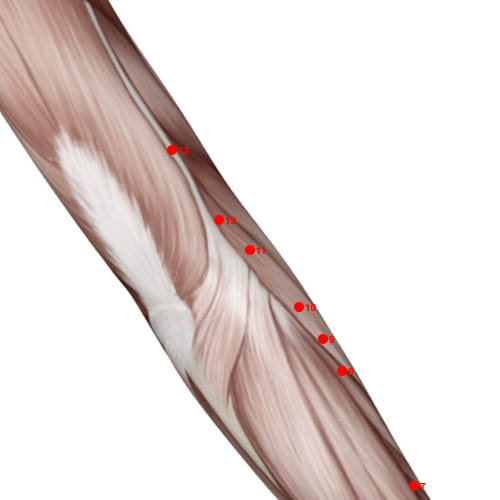
LU05Cubit Marsh

LU05 acupoint
Click to enlarge

Click to view all layers

Meridian: Lung Meridian

Chinese: 尺澤 (chǐ zé)

Location: On the cubital crease in the depression of the radial side of the biceps brachii tendon; point is located with elbow slightly flexed.

Cautions: Avoid in cases of severe vascular disease; caution with depth at cubital fossa.

Listed for: Cough, Diarrhea, Shortness of Breath, Asthma, Knee Pain

LU07Interrupted Sequence

LU07 acupoint
Click to enlarge

Click to view all layers

Meridian: Lung Meridian

Chinese: 列缺 (liè quē)

Location: Superior to the styloid process of the radius 1.5 thumb widths above the transverse crease of the wrist between brachioradialis and tendon of the abductor policis longus.

Cautions: Use with caution in patients with radial nerve sensitivity.

Listed for: Heat Chest, Cough, Fever, Shortness of Breath, Phlegm

LU09Great Source

LU09 acupoint
Click to enlarge

Click to view all layers

Meridian: Lung Meridian

Chinese: 太淵 (tài yuān)

Location: At the radial end of the transverse crease of the wrist in the depression on the lateral side of the radial artery.

Cautions: Caution in patients with cardiac arrhythmias; avoid excessive stimulation.

Listed for: Cough, Shortness of Breath, Asthma, Coughing Blood, Common Cold

Protocol (2 points)

GV20 · GV26

Study-reported

Point selection reported in a published study.

doi:10.13862/j.cnki.cn43-1446/r.2007.02.002 ↗
Not corroborated. No other study in the index uses any of these points for this search.
Locations and cautions2 points

GV20100 Convergences

GV20 acupoint
Click to enlarge

Click to view all layers

Meridian: Governing Vessel

Chinese: 百會 (bǎi huì)

Location: On the midline of the head 5 thumb widths directly above the midpoint of the anterior hairline approximately on the midpoint of the line connecting apex of the ears.

Cautions: No specific contraindications.

Listed for: Cough, Chest Pain, Palpitations, Jaundice, Qi Deficiency

GV26Philtrum

GV26 acupoint
Click to enlarge

Click to view all layers

Meridian: Governing Vessel

Chinese: 水溝 (shuǐ gōu)

Location: At the junction of the upper ⅓ and middle ⅓ of the philtrum.

Cautions: No specific contraindications.

Listed for: Fever, Jaundice, Depression, Wind, Chills

Protocol (2 points)

BL18 · BL23

Study-reported

Point selection reported in a published study.

doi:10.13862/j.cnki.cn43-1446/r.2007.02.002 ↗
Not corroborated. No other study in the index uses any of these points for this search.
Locations and cautions2 points

BL18Liver Shu Point

BL18 acupoint
Click to enlarge

Click to view all layers

Meridian: Bladder Meridian

Chinese: 肝俞 (gān shū)

Location: 1.5 thumb widths lateral to the GV08 at the level of the lower border of the spinous process of the 9th thoracic vertebra.

Cautions: Avoid deep perpendicular needling.

Listed for: Cough, Chest Pain, Dizziness, Coughing Blood, Jaundice

BL23Kidney Shu Point

BL23 acupoint
Click to enlarge

Click to view all layers

Meridian: Bladder Meridian

Chinese: 腎俞 (shèn shū)

Location: 1.5 thumb widths lateral to the GV04 at the level of the lower border of the spinous process of the 2nd lumbar vertebra.

Cautions: Avoid deep perpendicular needling.

Listed for: Cough, Diarrhea, Asthma, Tinnitus, Qi Deficiency

Protocol (2 points)

LI11 · ST36

Study-reported

Point selection reported in a published study.

doi:10.13862/j.cnki.cn43-1446/r.2007.02.002 ↗
Not corroborated. No other study in the index uses any of these points for this search.
Locations and cautions2 points

LI11Pond At The Bend

LI11 acupoint
Click to enlarge

Click to view all layers

Meridian: Large Intestine Meridian

Chinese: 曲池 (qū chí)

Location: When elbow is flexed point is in the depression the at the lateral end of the transverse cubital crease midway between LU05 and lateral epicondyle of the humerus.

Cautions: Monitor blood pressure and avoid strong stimulation where hypertension is uncontrolled or unstable; hypertensive crisis is a medical emergency. Avoid excessive stimulation in weak patients.

Listed for: Diarrhea, Dizziness, Heat, Vomiting, Abdominal Bloating

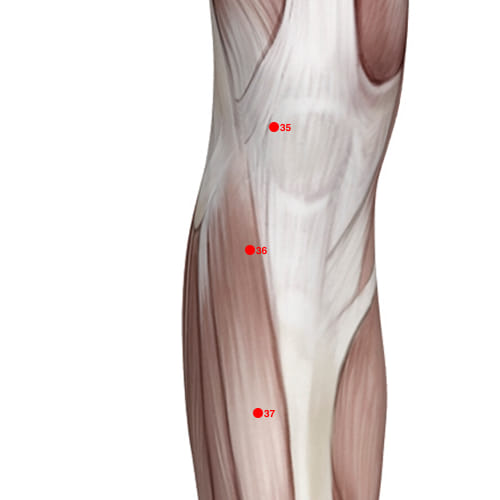
ST36Leg Three Miles

ST36 acupoint
Click to enlarge

Click to view all layers

Meridian: Stomach Meridian

Chinese: 足三里 (zú sān lǐ)

Location: 3 thumb widths below ST35, 1 finger breadth (middle finger) from anterior border of the tibia.

Cautions: Caution in cases of severe varicose veins.

Listed for: Cough, Fever, Poor Appetite, Diarrhea, Shortness of Breath

AcuiQ Self-Treatment Guide
Acupressure you can do at home, every protocol traced to a trial. – $12.99, free updates for life

Related symptoms

Often treated alongside Cerebral Ischemia Acute: