
Meridians & acupuncture points explorer
The fourteen channels, with every point AcuiQ has catalogued on each. Where the point-code standards disagree with one another, the disagreement is documented below.
The fourteen channels
Showing 21 of 21 meridians
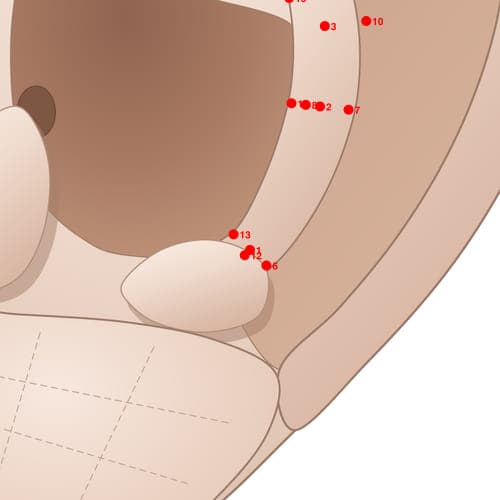
Auricular Points
Points on the outer ear, each mapped to a region of the body. Codes follow this catalogue’s numbering, which does not match the international standard everywhere – the research page on point codes records where.
184 acupoints
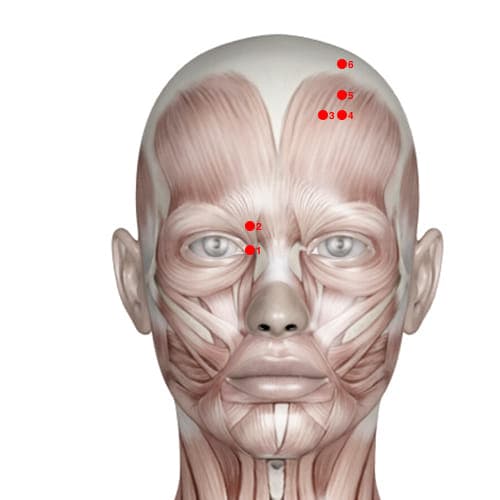
Bladder Meridian
Foot Taiyang. Runs from BL01 at the inner corner of the eye over the head, down both sides of the spine and the back of the leg to BL67 at the little toe. The longest channel, and the one that carries the back-shu points beside the spine.
Element: Water
67 acupoints
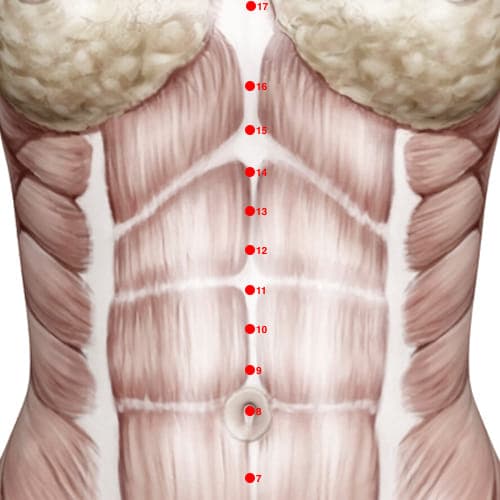
Conception Vessel
Ren Mai. Runs up the midline of the front of the body from CV01 at the perineum to CV24 below the lower lip. One of the two extraordinary vessels with points of its own.
24 acupoints
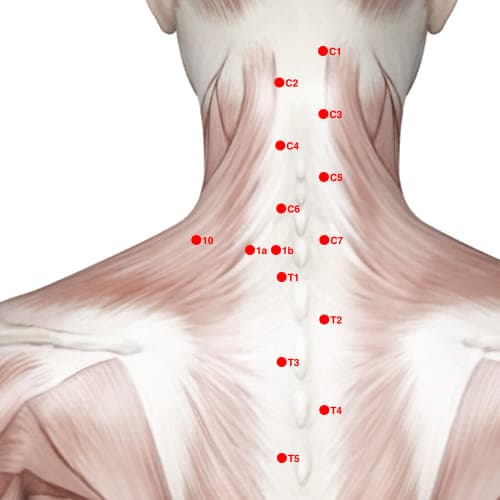
Extra Points: Back
Points on the back that sit off the channels, including the Huatuojiaji points beside each vertebra. EX-B in the WHO nomenclature.
42 acupoints
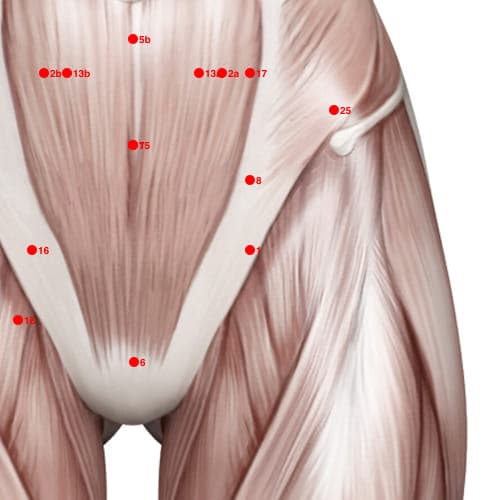
Extra Points: Chest & Abdomen
Points on the chest and abdomen that sit off the channels. EX-CA in the WHO nomenclature.
35 acupoints
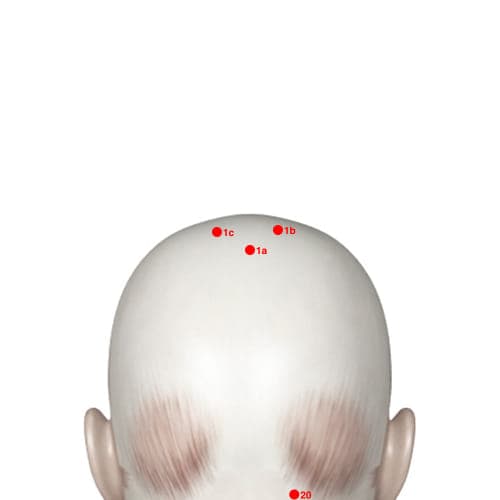
Extra Points: Head
Points on the head and neck that sit off the fourteen channels – Yintang between the eyebrows, Taiyang at the temple, the four Sishencong points around the vertex. EX-HN in the WHO nomenclature.
51 acupoints
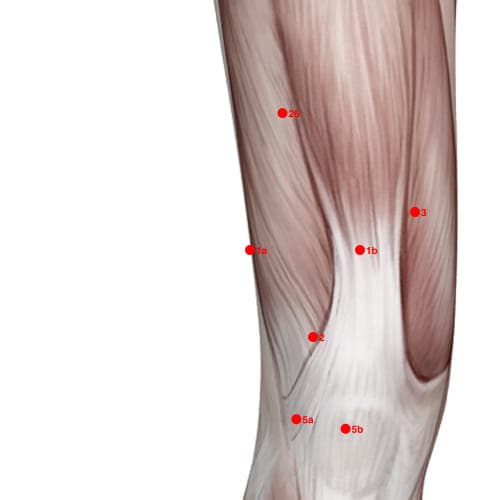
Extra Points: Lower limbs
Points on the leg and foot that sit off the channels – Xiyan at the knee, Bafeng between the toes. EX-LE in the WHO nomenclature.
35 acupoints
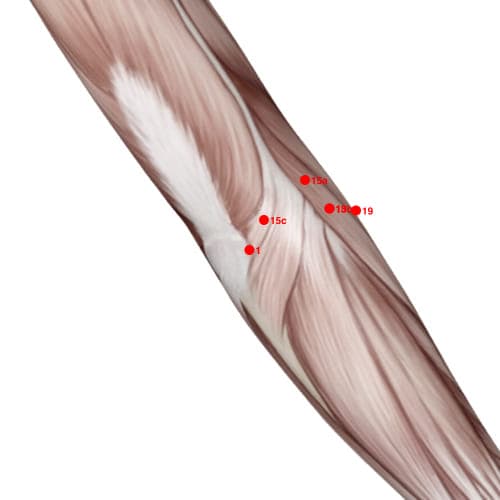
Extra Points: Upper limbs
Points on the arm and hand that sit off the channels – Baxie between the knuckles, Shixuan at the fingertips. EX-UE in the WHO nomenclature.
51 acupoints
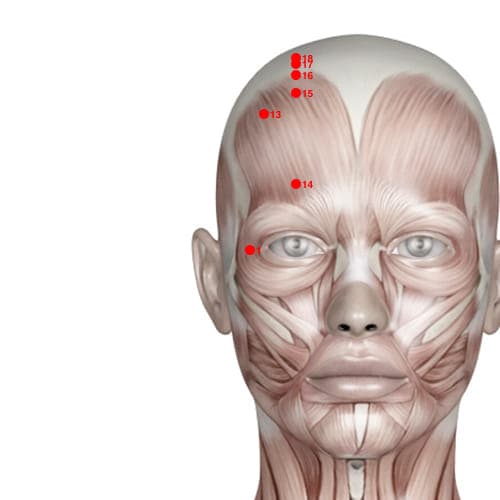
Gallbladder Meridian
Foot Shaoyang. Runs from GB01 at the outer corner of the eye, back and forth over the side of the head, down the flank and the outer leg to GB44 at the fourth toe.
Element: Wood
44 acupoints
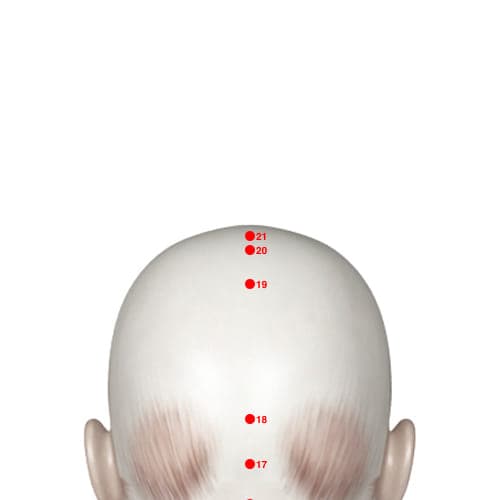
Governing Vessel
Du Mai. Runs up the midline of the back from GV01 at the coccyx, over the head to GV28 inside the upper lip. One of the two extraordinary vessels with points of its own.
28 acupoints
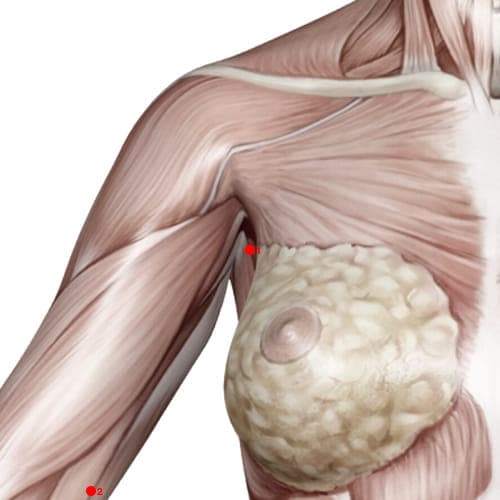
Heart Meridian
Hand Shaoyin. Runs from HT01 in the armpit down the inner arm to HT09 at the little fingernail – nine points, the fewest of any main channel.
Element: Fire
9 acupoints
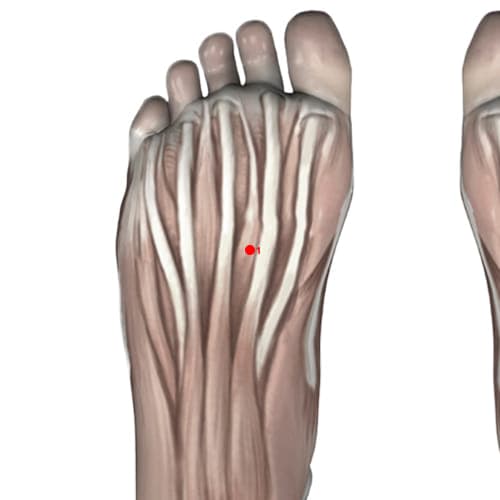
Kidney Meridian
Foot Shaoyin. Runs from KD01 on the sole up the inner leg and the front of the trunk to KD27 below the collarbone. Paired with the Bladder channel. KD here; KI in the WHO nomenclature.
Element: Water
27 acupoints
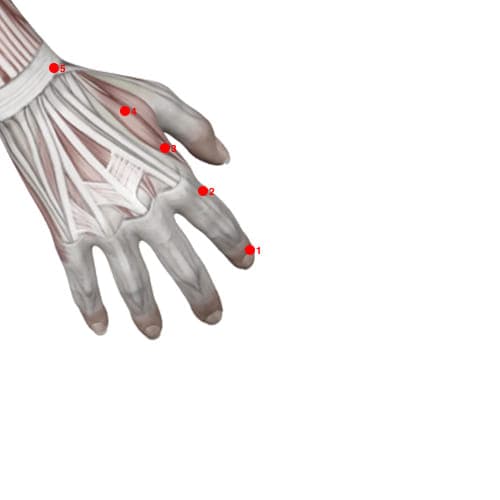
Large Intestine Meridian
Hand Yangming. Runs from LI01 at the index fingernail up the outer arm, over the shoulder and neck to LI20 beside the nostril. Paired with the Lung channel.
Element: Metal
20 acupoints
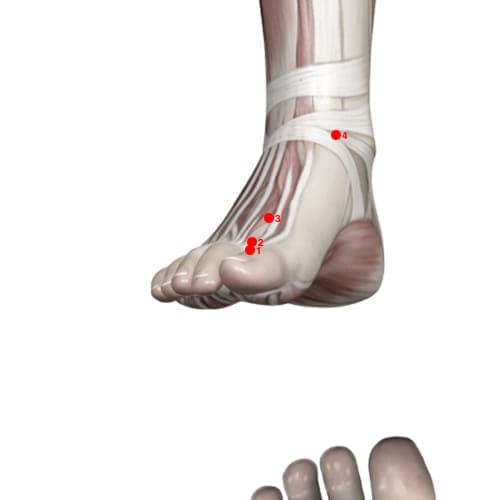
Liver Meridian
Foot Jueyin. Runs from LV01 at the big toe up the inner leg and the groin to LV14 below the nipple. LV here; LR in the WHO nomenclature.
Element: Wood
14 acupoints
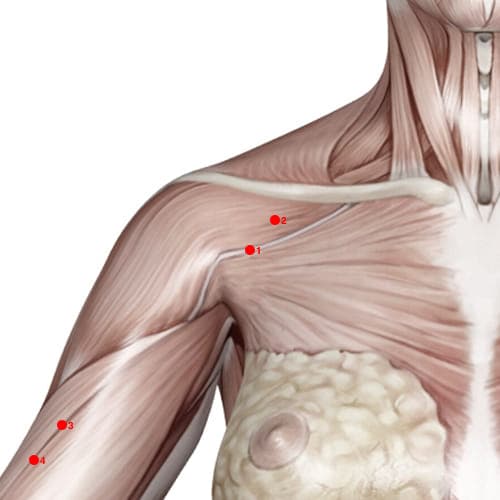
Lung Meridian
Hand Taiyin. Runs from LU01 below the collarbone down the inner arm to LU11 at the thumbnail. Paired with the Large Intestine channel.
Element: Metal
11 acupoints
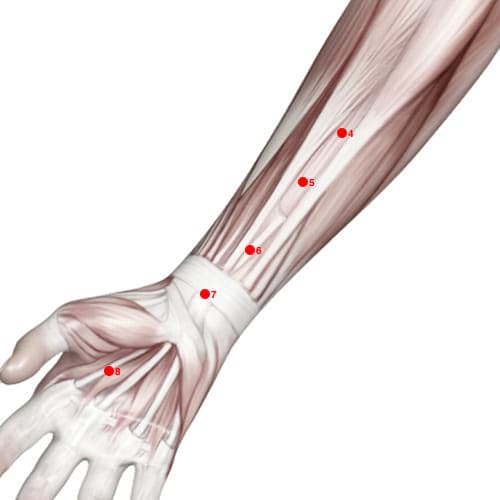
Pericardium Meridian
Hand Jueyin. Runs from PC01 beside the nipple down the middle of the inner arm to PC09 at the tip of the middle finger.
Element: Fire
9 acupoints
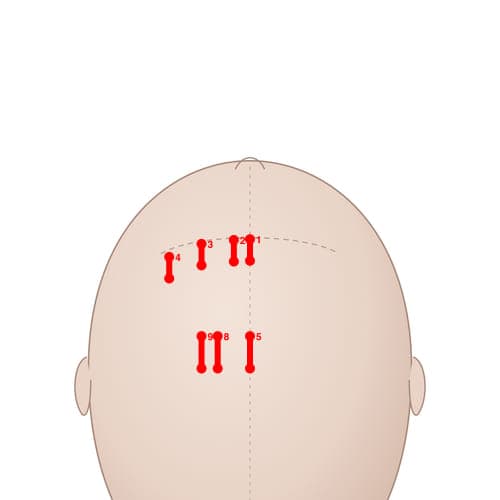
Scalp Lines
Standard scalp acupuncture lines (MS1-MS14) from the WHO Standard Acupuncture Nomenclature. Each is a line over a cortical projection area rather than a point on a channel, and is needled along its length.
14 acupoints
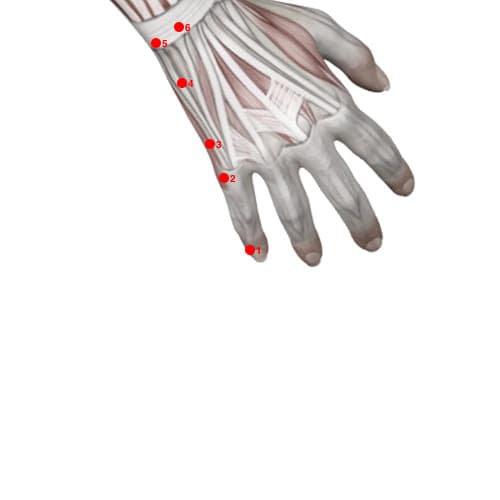
Small Intestine Meridian
Hand Taiyang. Runs from SI01 at the little finger up the back of the arm and over the shoulder blade to SI19 in front of the ear. Paired with the Heart channel.
Element: Fire
19 acupoints
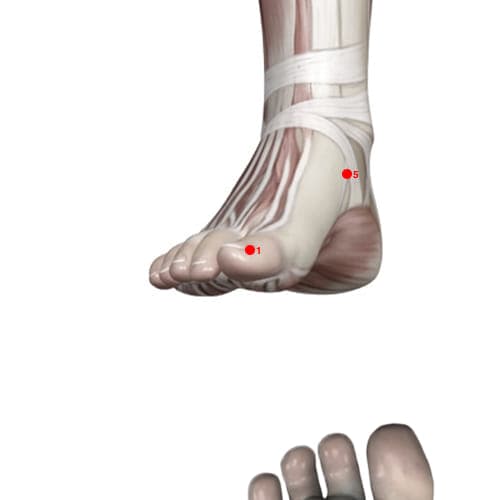
Spleen Meridian
Foot Taiyin. Runs from SP01 at the big toe up the inner leg and the abdomen to SP21 on the side of the chest. Paired with the Stomach channel.
Element: Earth
21 acupoints
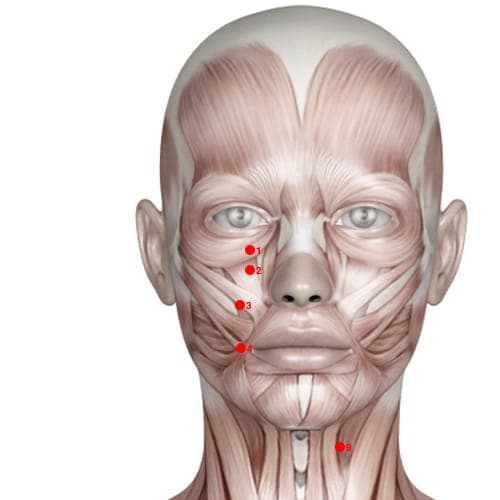
Stomach Meridian
Foot Yangming. Runs from ST01 below the eye down the face, the front of the trunk and the outer leg to ST45 at the second toe – the long channel on the front of the body.
Element: Earth
45 acupoints
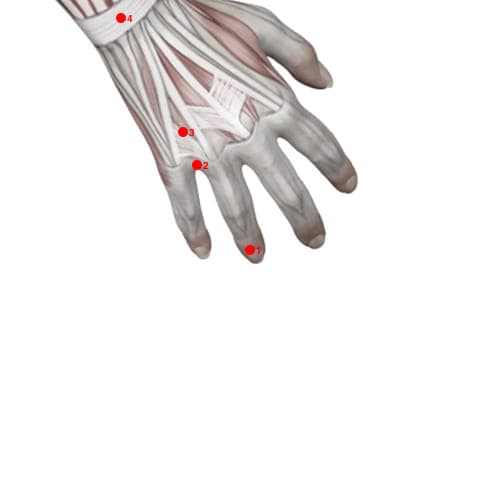
Triple Burner Meridian
Hand Shaoyang. Runs from TB01 at the ring finger up the back of the arm and around the ear to TB23 at the outer end of the eyebrow. TB here; TE in the WHO nomenclature.
Element: Fire
23 acupoints
About the channels
What a channel is
Classical Chinese medicine groups the acupoints into channels and names most of them for an organ. That grouping is the tradition's own map. AcuiQ records which points published sources prescribed, and does not test the map.
- The channel system, counted: how the standards number the channels and their points
- Reading a point code: what a code such as LI04 stands for
- Reading a point warning, and the points classical texts forbid in pregnancy
The most-cited points
The points the most protocols in the index prescribe, out of the 6,965 that name a point. A count of what the sources did, not a recommendation.
- ST36 (zú sān lǐ): 2,302 protocols
- LI04 (hé gǔ): 1,759 protocols
- SP06 (sān yīn jiāo): 1,732 protocols
- GV20 (bǎi huì): 1,361 protocols
- PC06 (nèi guān): 1,284 protocols
- LV03 (tài chōng): 1,185 protocols
A note on point codes
Point codes are less universal than they look. Acupuncture has several careful standards rather than one: the World Health Organization published standard point locations in 2008 and a nomenclature covering the 361 classical points, 48 extra points and 14 scalp lines in 1991, while China maintains GB/T 12346 for channel points and GB/T 13734 for auricular points, and the World Federation of Acupuncture-Moxibustion Societies publishes its own. Each is internally consistent. They do not always agree with one another.
Channel points are the stable part. LI4 means Hegu everywhere, and the codes you see on this site follow the standard forms, with KD for the kidney channel, LV for liver, TB for the triple burner, and CV and GV for the two extraordinary vessels you will also see written as Ren and Du. Auricular points are the unstable part. Ear point nomenclature was proposed to the WHO in 1990 and never ratified, so it developed nationally instead, and two schemes can use the same prefix and number for different points. TF4 is Shenmen under the international standard and a hypotensive point in other catalogues.
This matters when you compare a protocol here against one you read elsewhere. If an ear point code does not seem to match, the two sources are probably counting from different origins rather than disagreeing clinically. We have written up what it cost us to discover the problem.