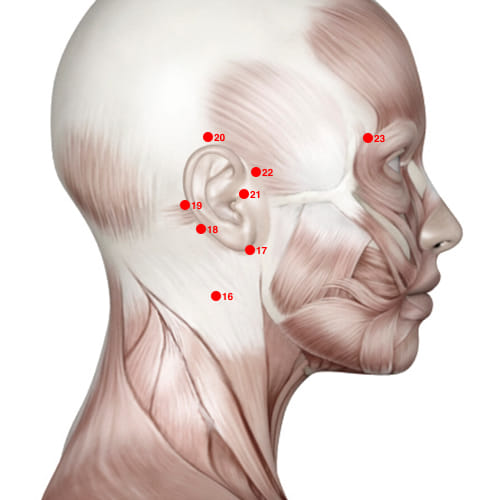
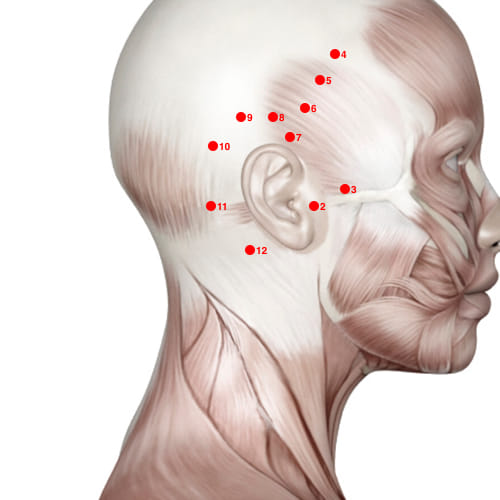
Acupuncture Points for Palsy Oculomotor

1 sourced protocol, each with its citation.

Points cited for Palsy Oculomotor

How often each point appears across the 1 entries ranked highest for Palsy Oculomotor. Citation frequency, not a recommendation.

  • BL01Bright Eyes / Eye PointBladder Meridian1 of 1
  • BL02Gathered BambooBladder Meridian1 of 1
  • GB03Above The ArchGallbladder Meridian1 of 1
  • GB12Mastoid ProcessGallbladder Meridian1 of 1
  • GB20Wind PoolGallbladder Meridian1 of 1
  • ST01Tear ContainerStomach Meridian1 of 1
  • TB17HurricaneTriple Burner Meridian1 of 1
  • TB23Silken Bamboo HollowTriple Burner Meridian1 of 1

How the studies delivered it

What the 1 studies behind the entries above ran, counted once per study. A record of the trials, not a recommendation.

  • Needling1 of 1
  • Electroacupuncture1 of 1

After a treatment: what large safety surveys recorded, and which reactions need a doctor.

Each card names its evidence kind. What these labels mean

Protocol (8 points)

ST01 · BL01 · BL02 · TB17 · TB23 · GB03 · GB12 · GB20

Study-reported

Needling + Electroacupuncture

Point selection reported in a published study.

doi:10.1097/MD.0000000000043279 ↗
Locations and cautions8 points

ST01Tear Container
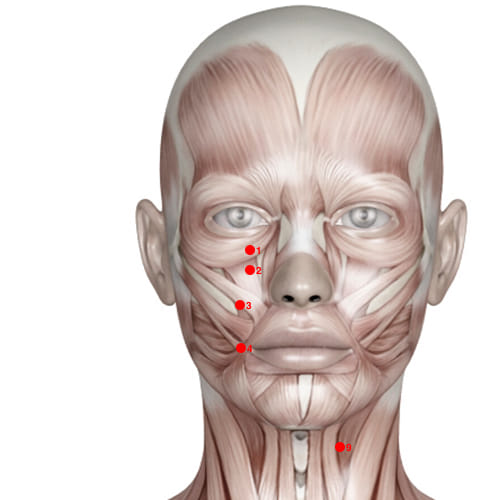
ST01 acupoint
Click to enlarge

Click to view all layers

Meridian: Stomach Meridian

Chinese: 承泣 (chéng qì)

Location: With eyes looking straight forward, point is directly below pupil between eyeball and infraorbital ridge.

Cautions: Contraindicated for direct needling; use only pressure.

Listed for: Tinnitus, Common Cold, Heat, Wind, Redness

BL01Bright Eyes / Eye Point
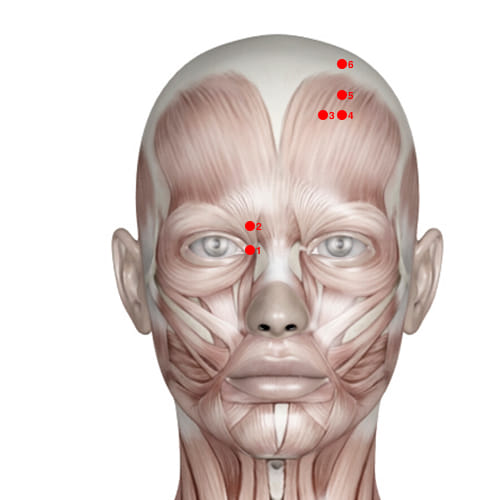
BL01 acupoint
Click to enlarge

Click to view all layers

Meridian: Bladder Meridian

Chinese: 睛明 (jīng míng)

Location: In the depression the slightly above the inner canthus.

Cautions: Contraindicated for direct needling; use only pressure.

Listed for: Heat, Wind, Redness, Swelling, Aversion Cold
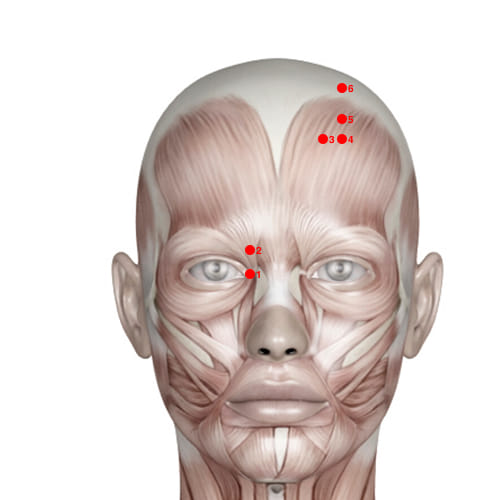
BL02Gathered Bamboo

BL02 acupoint
Click to enlarge

Click to view all layers

Meridian: Bladder Meridian

Chinese: 攢竹 (cuán zhú)

Location: On the medial extremity of the eyebrow or on the supraorbital notch.

Cautions: Caution with supraorbital nerve.

Listed for: Dizziness, Wind, Redness, Swelling, Pain

TB17Hurricane

TB17 acupoint
Click to enlarge

Click to view all layers

Meridian: Triple Burner Meridian

Chinese: 翳風 (yì fēng)

Location: Posterior to the lobule of the ear in the depression the between mandible and mastoid process.

Cautions: Caution near facial nerve.

Listed for: Heat, Wind, Pain, Deviation Eye, Facial Droop

TB23Silken Bamboo Hollow
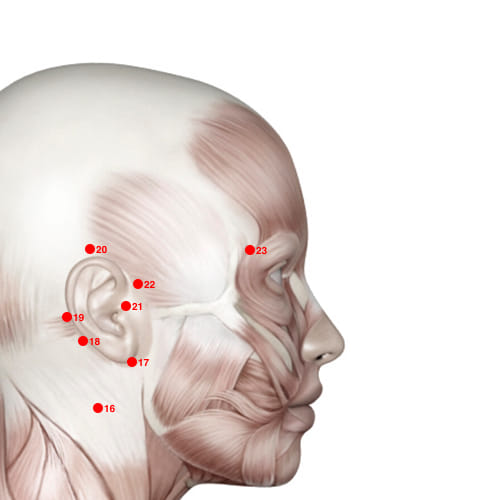
TB23 acupoint
Click to enlarge

Click to view all layers

Meridian: Triple Burner Meridian

Chinese: 絲竹空 (sī zhú kōng)

Location: In the depression the at the lateral end of the eyebrow.

Cautions: Caution near eye.

Listed for: Dizziness, Wind, Pain, Aversion Cold, Deviation Eye
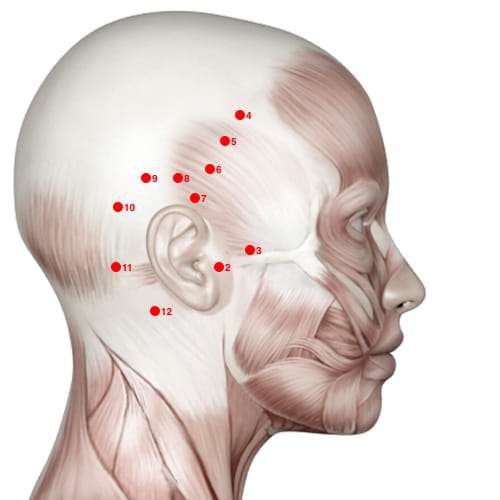
GB03Above The Arch

GB03 acupoint
Click to enlarge

Click to view all layers

Meridian: Gallbladder Meridian

Chinese: 上關 (shàng guān)

Location: In the front of the ear on the upper border of the zygomatic arch in the depression the directly above the ST07.

Cautions: Caution with temporal artery.

Listed for: Fever, Tinnitus, Wind, Pain, Chills

GB12Mastoid Process

GB12 acupoint
Click to enlarge

Click to view all layers

Meridian: Gallbladder Meridian

Chinese: 完骨 (wán gǔ)

Location: In the depression the posterior and inferior to the mastoid process.

Cautions: No specific contraindications for head points.

Listed for: Wind, Pain, Deviation Eye, Facial Droop, Epilepsy
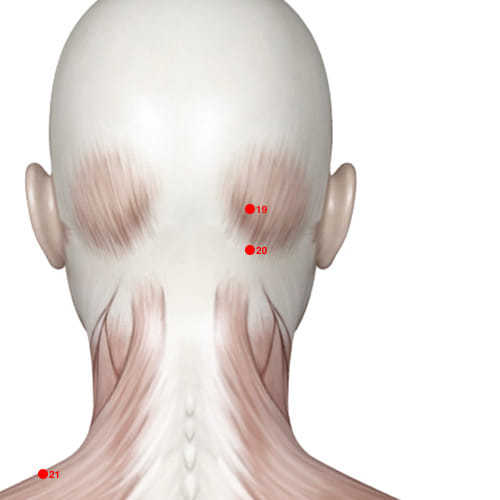
GB20Wind Pool

GB20 acupoint
Click to enlarge

Click to view all layers

Meridian: Gallbladder Meridian

Chinese: 風池 (fēng chí)

Location: In the depression the between upper portion of the scm and trapezius on the same level with GV16.

Cautions: Caution with vertebral artery; avoid deep perpendicular needling.

Listed for: Stress, Fever, Dizziness, Tinnitus, Wind

AcuiQ Self-Treatment Guide
Acupressure you can do at home, every protocol traced to a trial. – $12.99, free updates for life

Related symptoms

Often treated alongside Palsy Oculomotor: